
Sounding An Alarm!
Before oppression is written into law, it is almost always preached into legitimacy.
By Traci Blackmon
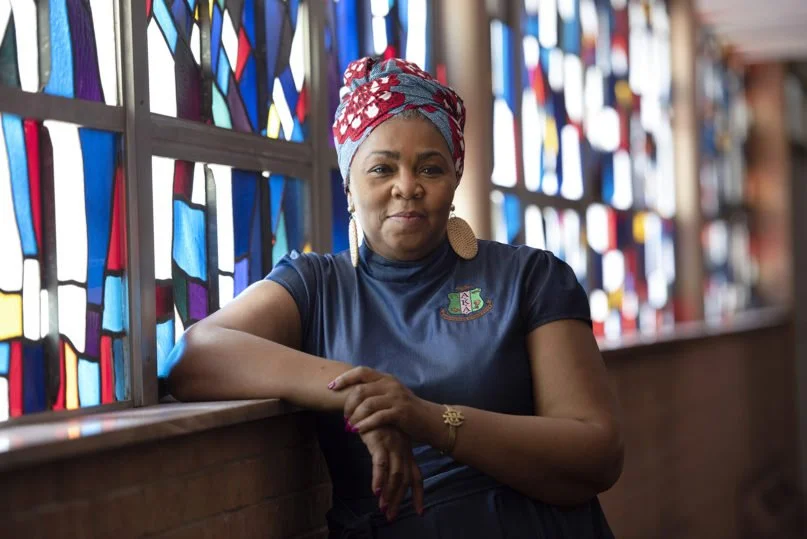
In the fall of 2023, I spent my sabbatical in Cape Town, South Africa. Through the extraordinary generosity of my dear friend, the Rev. René August, I experienced not only the breathtaking beauty of her homeland, but also its history through the eyes of someone whose vision had not been shaped by curated stories or redacted histories.
René is an Episcopal priest whose family’s story is deeply rooted in Cape Town. She possesses a rare gift: the ability to illuminate not only history’s wounds, but also the extraordinary resilience that struggle so often reveals.
During my month there, she introduced me to the South Africa tourists come to see: the open-air markets, the dramatic coastlines, and the place where two oceans meet. She taught me to drive on the left side of the road before graciously handing me the keys to her car. She welcomed me into gatherings of family and friends, invited me to listening sessions in townships, took me to a young artist’s exhibition, and shared countless evenings over good food, good wine, and spectacular sunsets
But the greatest gift she gave me was conversation.
History. Theology. Sociology. Soteriology.
Conversations that linger with me still.
One day, René pointed out Groote Kerk while we were riding through the city. Groote Kerk “The Great Church” is the oldest Christian church in South Africa, established by Dutch colonists in the seventeenth century.
It is also the place where the theology of apartheid was first preached.
The architects of apartheid were not content merely to create a political system. They sought something more enduring: divine legitimacy.
They taught that racial segregation was not simply good policy but God’s will. Not merely a political preference, but a sacred obligation.
To give apartheid moral weight, theologians selectively interpreted Scripture until oppression appeared righteous. Forced removals, the denial of political rights, and the degradation of Black, Coloured, and Asian South Africans became, for many, not acts of cruelty but acts of obedience.
On my final Sunday in South Africa, I chose Groote Kerk as my place of worship.
René had kindly alerted the pastor that I would be attending, and his hospitality was warm. Still, I sat alone. As worship began, I realized I would understand almost none of the sermon being preached in Afrikaans.
The language barrier should have been the most unsettling part of the morning.
It wasn’t.
Instead, my mind drifted thousands of miles north to Elmina Castle on Ghana’s coast, a place I’ve visited several times.
Originally constructed by the Portuguese in 1482 and later occupied by the Dutch, Elmina became one of the principal slave-trading forts of the transatlantic slave trade. Above ground, Europeans conducted commerce and daily life. Beneath them, captured Africans were separated from their families, raped, tortured, starved, and imprisoned for weeks or months before being forced through the infamous “Door of No Return.”
In the middle of that castle sits a church.
The people who brutalized enslaved Africans gathered there to pray.
To sing.
To worship.
Not every slave fort contained a chapel. But many of the largest European forts built churches directly above, or beside, the dungeons where human beings were held.
The proximity of the sanctuary to the suffering was no accident. It was theology.
The holy stood beside the profane until the profane came to be called holy.
History teaches us that before oppression is enforced by law, it is almost always justified by theology.
That is why the report released yesterday by President Trump’s Religious Liberty Commission should concern anyone who loves both faith and democracy.
Not because religion has no place in public life. It does.
But because history teaches us what happens when governments begin confusing the authority of the church with the authority of the state.
The commission rejects the longstanding metaphor of a “wall of separation” between church and state, urging instead that America build “bridges” between them while recommending a significantly expanded role for religion in public institutions.
That language feels familiar.
Not because America has heard it before.
Because the Church has.
Every generation that has sought to sanctify domination has first wrapped itself in Scripture.
The theology of apartheid did not begin in Parliament.
It began in the pulpit.
The theology of American slavery did not begin in Congress.
It began in churches.
Long before legislators wrote laws, preachers preached sermons. Before judges issued rulings, theologians wrote treatises.
Before governments enforced segregation, Christians declared segregation to be the will of God.
Law follows imagination.
And imagination is often formed by theology.
That is why Groote Kerk unsettled me.
That is why Elmina Castle broke my heart.
In both places, worship was offered while human dignity was denied.
The sanctuary stood only steps away from unspeakable suffering, not because the worshippers lacked compassion, but because their theology had taught them that domination could be holy.
That is always how it begins.
Not with hatred.
With hermeneutics.
Not with violence.
With interpretation.
Not with legislation.
With liturgy.
The most dangerous theology is never the one that announces itself as evil.
It is the one convinced it is righteous.
Less than a kilometer from Groote Kerk stands the legacy of Archbishop Desmond Tutu, who spent decades insisting that apartheid was not merely bad politics.
It was heresy, not because it separated races. But rather because it separated the Gospel from the God who gave it.
Tutu understood something the Church must remember again.
Whenever Christianity becomes useful to political power, political power eventually begins redefining Christianity.
Faith loses its prophetic voice the moment it becomes the chaplain of empire.
The Church’s calling has never been to rule the state.
Nor is the state’s calling to define the Church.
Religion is the work of faith communities.
Democracy is the work of the state.
One is sustained by invitation.
The other by obligation.
One forms the conscience.
The other protects the common good.
To weaken the integrity of either is to diminish the power of both.
Cape Town remembers.
Elmina remembers.
The question is whether America is willing to remember before history asks us to relive what others have already survived, because the distance between a sanctuary and a dungeon is often only a staircase.
The distance between faithful witness and baptized oppression is only a theology.
Rev. Traci Blackmon is a Trustee of the Samuel DeWitt Proctor Conference, Inc. and Founder of Faith Out Loud. Visit Rev. Blackmon’s Substack, “My View from Hagar’s Porch. (https://open.substack.com/pub/traciblackmon883511/p/sounding-an-alarm?r=592uy&utm_medium=ios)
