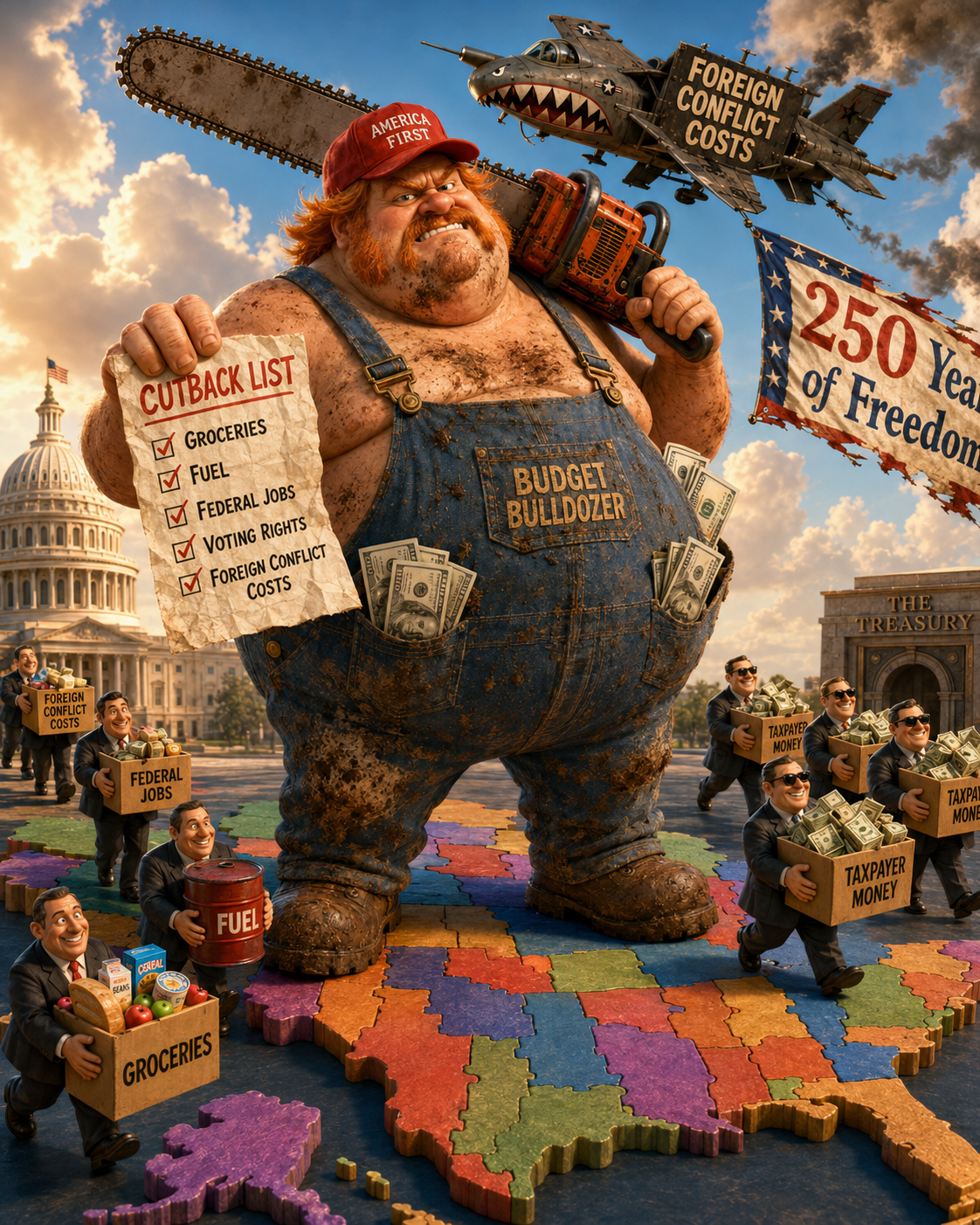
The Freedom to Destroy Freedoms
Public Policy, Democratic Erosion, and the Counter-Narratives America Refuses to Remember
A Critical Essay on the 250th Anniversary of the United States of America, 2026
By Rev. Damien Durr
I. Introduction: The Paradox of Jubilee
In 2026, the United States of America will pause to celebrate itself. With fireworks, fanfare, and the full machinery of national mythology, the country will mark its 250th anniversary a proclaiming to the world and to itself that the great American experiment in liberty continues. Politicians will quote the Declaration of Independence. Flags will be raised. Speeches will invoke the founders. And the word “freedom” will be spoken more times in a single day than perhaps any other word in the English language.
But freedom for whom?
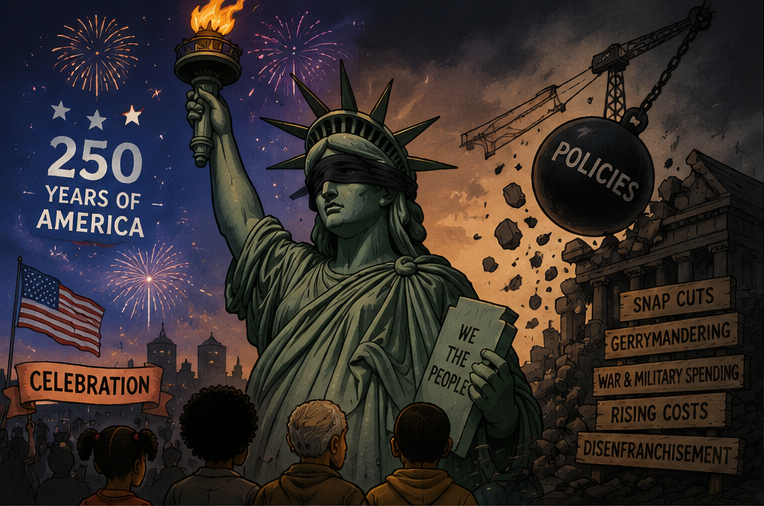
This essay argues that the 250th anniversary of American independence arrives at a moment of profound and dangerous contradiction. Even as the nation prepares to celebrate its founding ideals, the machinery of government is being wielded with surgical precision to dismantle the very freedoms it claims to honor. Public policy has become a weapon. The language of liberty has become a cover for denial. And those who have historically been denied the full promise of American democracy are once again bearing the greatest cost.
This is not new. It is, in fact, one of the oldest American traditions: the simultaneous proclamation of freedom and the systematic destruction of it, particularly for Black Americans, poor communities, and the most vulnerable among us. What is new is the brazenness, the degree to which these contradictions are playing out in the open, in real time, in a year that was supposed to be about celebration.
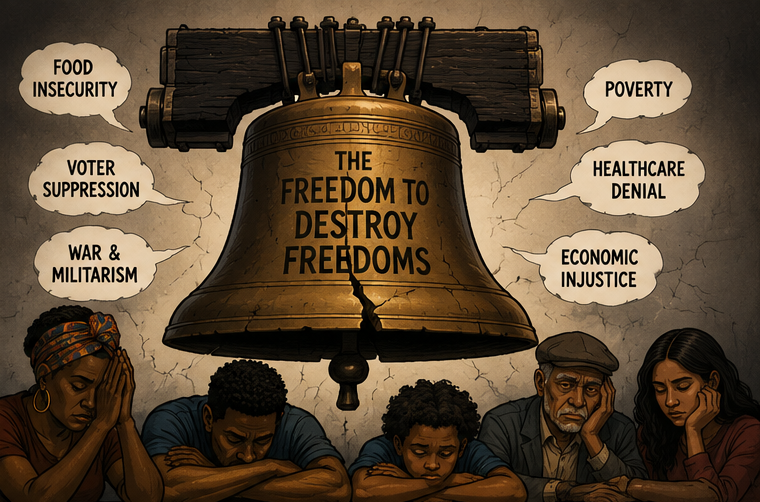
To celebrate 250 years of American freedom while millions of people are losing access to food, healthcare, economic stability, and democratic representation is not a celebration of freedom. It is a monument to the freedom to destroy freedoms.
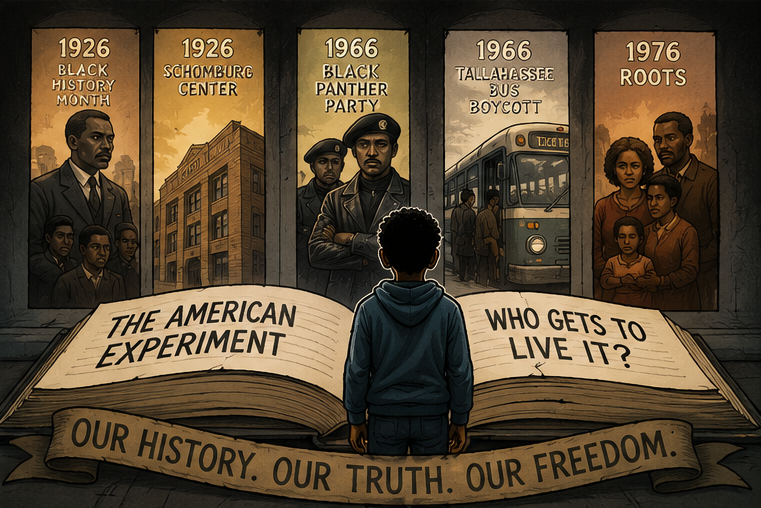
This essay refuses to let that contradiction go unnamed. It places the present moment in conversation with the commemorations of 2026 that the dominant culture would prefer to overlook: the 100th anniversary of Black History Month; the centennial of the Schomburg Center for Research in Black Culture; the 60th anniversary of the founding of the Black Panther Party for Self-Defense; the 60th commemoration of the Tallahassee Bus Boycott; and the 50th anniversary of the landmark film and television event Roots. These are not footnotes to the American story. They are, in many ways, its most honest chapters.
II. The Architecture of Dismantling: Policy as Weapon in 2026
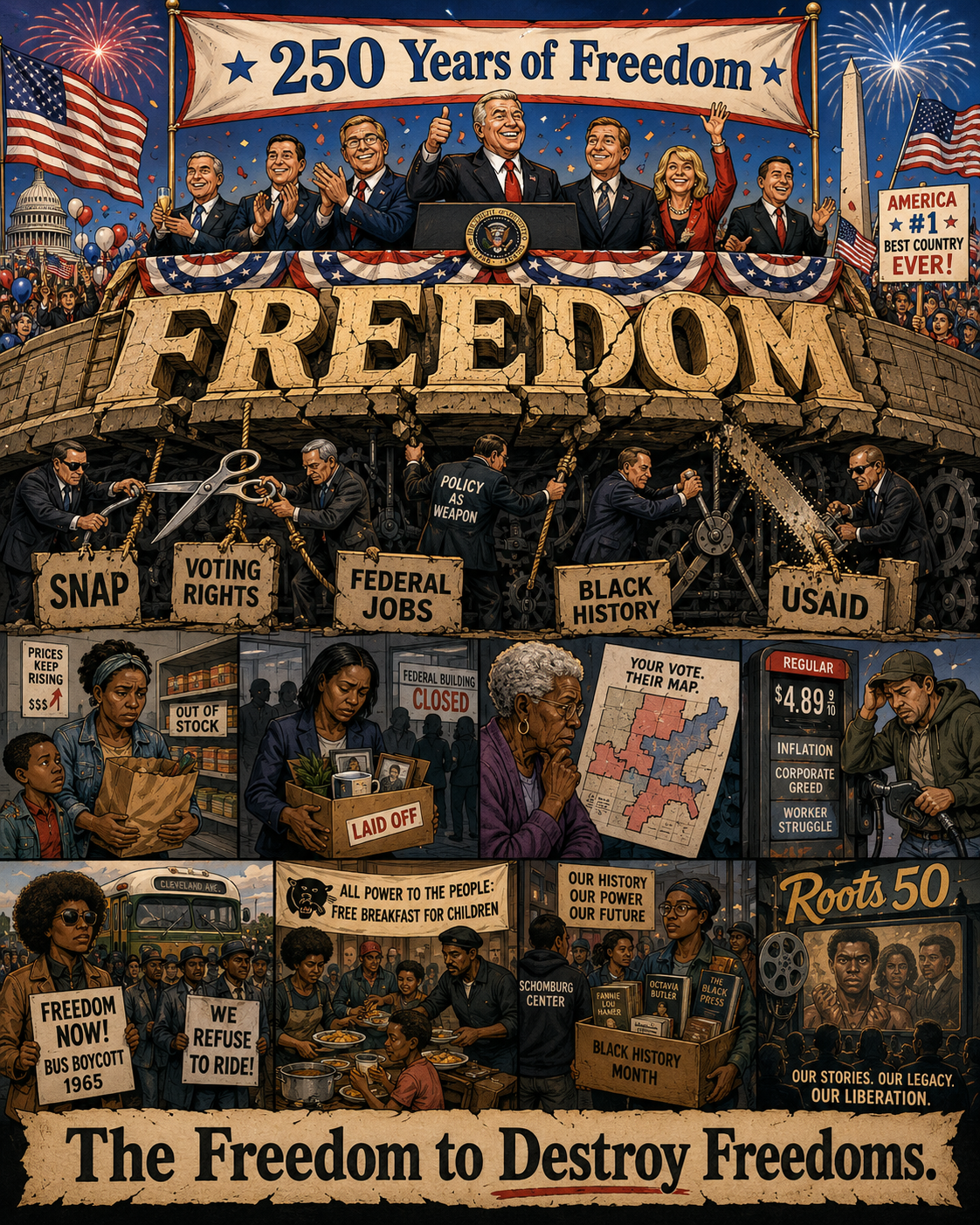
The current political moment cannot be understood apart from its specific policy choices. Abstract language about “freedom” and “equality” obscures what is actually happening on the ground. To see clearly, we must name what is being done, to whom, and by whom.
The Hunger of Governance: SNAP Benefit Cuts
Among the most consequential and least discussed attacks on freedom in 2026 is the systematic reduction of SNAP benefits: the Supplemental Nutrition Assistance Program — that serves more than 42 million Americans. Food insecurity is not an abstraction. It is a direct attack on the capacity of human beings to survive, to think, to work, and to participate in civic life. When a government cuts food benefits in the name of fiscal responsibility or “encouraging self-sufficiency,” it is not neutral governance. It is a political choice with racialized consequences, given that Black and Brown households are disproportionately represented among SNAP recipients.
The freedom to eat, the most elemental of freedoms, is being rationed by policy. And this is happening in a year that is supposed to celebrate liberty.
Redrawing the Map: Gerrymandering and the Erosion of Representation
The ongoing effort to redraw electoral maps across the country is not a technical exercise in democratic administration. It is a deliberate strategy to dilute Black political power, to fracture communities of color into electoral irrelevance, and to entrench minority rule under the cover of procedural legitimacy. When district lines are drawn to crack and pack Black voters, the result is that the votes of millions of Americans are rendered functionally meaningless.
This is the freedom to destroy freedoms in its most precise form: using the tools of democracy to undermine democratic participation itself. The 15th Amendment promised Black men the vote in 1870. The Voting Rights Act of 1965 tried to make that promise real. In 2026, the map is being redrawn to diminish that promise.
War and Its Discontents: The Cost of Conflict in Iran
Military engagement in Iran: whether through direct conflict, sanctions, or proxy operations, carries costs that are never evenly distributed. The young men and women who fight in American wars are disproportionately drawn from communities that are already economically marginalized. The veterans who return bear wounds, visible and invisible, that their communities are ill-equipped to treat. The financial resources consumed by military engagement are resources diverted from the domestic investments that could transform life in those same communities.
There is also the moral cost. When a nation launches or escalates conflict abroad while cutting food assistance at home, it announces its priorities clarity: the projection of power matters more than the lives of its most vulnerable citizens.
The Price of Everything: Rising Gas Prices and the Poverty Tax
Rising gas prices function almost as an extended tax on the poor. For Americans who must drive to work, who live in communities without public transportation infrastructure, who cannot afford hybrid vehicles or urban proximity to employment centers, fuel costs are not an inconvenience. They are a crisis. When gas prices rise, the ripple effects touch food costs, childcare logistics, medical access, and the basic calculus of economic survival.
This is the invisible architecture of inequality: structural conditions that insulate hardship among those who already have the least, while those with capital insulate themselves from the consequences. In this year of liberty for all, the poorest Americans are effectively paying a freedom tax for the privilege of simply getting to work.
The Erasure of Black Women: Federal Layoffs and Economic Violence
The disproportionate layoffs of Black women from federal employment represent one of the most targeted and least-discussed forms of economic violence. Black women have long found in federal employment a rare space of relative pay equity, professional advancement, and economic stability that the private sector has consistently denied them. To systematically remove Black women from the federal workforce whether through agency restructuring, ideological purges under the guise of “efficiency,” or the dismantling of DEI infrastructure is to strike at one of the few institutional ladders that has allowed Black women to build and sustain middle-class lives.
The numbers, as they have continued to emerge, are staggering in their specificity. Black women accounted for roughly a third of all federal job losses in 2025. Their unemployment rate climbed to 7.5 percent by the fall of 2025, nearly double the national average at the time. The Department of Education, one of the most targeted agencies under DOGE restructuring, counted Black women as more than a quarter of its workforce. As the Economic Policy Institute has documented, the overall net employment loss for Black women in 2025 was driven almost entirely by public-sector cuts, and the losses fell hardest on college graduates, on the credentialed and the experienced, on women who had done everything that the American promise said they were supposed to do. By March 2026, 9 percent of the entire federal civilian workforce had been eliminated. The federal government, one of the few institutions in American life that had offered Black women something approaching equitable employment has been deliberately, systematically dismantled.
It is not coincidental. It is not collateral damage. It is a policy choice whose effects are predictable and whose targets are specific.
Shutting Down the World: The Elimination of USAID
The closure or gutting of the United States Agency for International Development represents a retreat from the global commitments that American foreign policy has, for decades, used as evidence of its benevolence. Whatever the legitimate critiques of USAID and there are many, its dismantling removes a critical infrastructure of humanitarian support that affects millions of people across Africa, Latin America, Asia, and the Caribbean, many of whom are Black and Brown. The ideological motivation is transparent: a retrenchment of global engagement under the banner of “America First” nationalism.
The irony is acute. A nation celebrating its founding ideals of freedom and human dignity is simultaneously withdrawing from its commitments to human dignity beyond its borders. Freedom, it turns out, does not travel well when it is inconvenient.
III. The Guise: Equality, Expansion, and the Language of Reversal
Perhaps the most insidious dimension of the current assault on freedoms is the language in which it is dressed. The attacks described above are not presented as what they are: reversals, contractions, and targeted deprivations. They are presented as expansions of freedom, corrections of unfair advantage, and returns to meritocracy and equality.
Cutting SNAP benefits is called promoting self-reliance. Gerrymandering is called fair redistricting. Layoffs of Black women from federal agencies are called restoring merit-based hiring. Shutting down USAID is called protecting taxpayer dollars. Each act of constriction is re-labeled as liberation. Each removal of a floor is reframed as a leveling of the playing field.
After Reconstruction, the restoration of white supremacist governance was called “Redemption.” After the Civil Rights Movement, the backlash against its gains was called “law and order.” After affirmative action created pathways for Black students and workers, its dismantling was called “color-blindness.” The language changes. The structure remains.
The most effective strategy for destroying freedom has always been to do it in freedom's name: to use the vocabulary of rights and equality to reverse the hard-won gains of those who fought to make those words real.
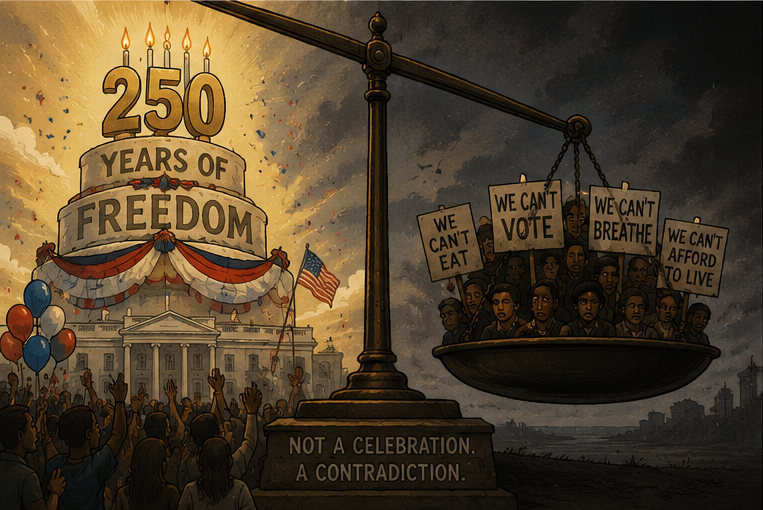
In 2026, as the nation gathers under the banner of “250 Years of Freedom,” we must consider the contradiction before us in plain sight: the freedom being celebrated is being rationed, weaponized, and selectively distributed. And those who are paying the price are the descendants of the people who were never fully included in the original promise.
IV. Counter-Narratives: What 2026 Also Marks
The dominant celebration of America’s 250th anniversary will tell one story. It will be a story of progress, resilience, and the steady expansion of liberty. It will center founders and documents, battlefields and monuments. It will be partial, curated, and politically convenient.
But 2026 is also a year of other anniversaries: commemorations that tell a different and more complete story of what America has been, and what Black Americans have built in the face of what it has done to them. These are not counter-American stories. They are deeply American stories. They are, in many ways, the most American stories of all.
100 Years of Black History Month: The Radical Act of Remembering
Black History Month, now celebrating its centennial, was born in 1926 as Negro History Week, founded by historian and scholar Carter G. Woodson and the Association for the Study of Negro Life and History. Woodson understood that the suppression of Black history was not accidental, it was a political project. A people robbed of their history could be kept in a state of psychological subjugation, unable to understand the roots of their condition or the depth of their capacity.
The creation of a dedicated week, later expanded to a month was a radical assertion: that Black life, Black achievement, Black struggle, and Black culture were worthy of formal commemoration and study. Now one hundred years later, that assertion is under attack. State legislatures are restricting what can be taught about Black history. School boards are pulling books. “Diversity” has become equated with underserving or unfairly advantaged. And yet, here is Black History Month, entering its second century, still standing.
The centennial of Black History Month in 2026 is not simply a calendar milestone. It is a testament to the endurance of the radical act of remembering and a rebuke to every power that has tried to make Black people forget who they are.
100th Anniversary — Black History Month (founded 1926 by Carter G. Woodson)
100 Years of the Schomburg Center: A Cathedral of Black Knowledge
In 1926, the same year Carter Woodson launched Negro History Week, the New York Public Library acquired the extraordinary personal collection of Arturo Alfonso Schomburg, an Afro-Puerto Rican scholar and activist whose lifelong mission was to document and preserve the history and culture of people of African descent. That collection became the foundation of what is now the Schomburg Center for Research in Black Culture, located in Harlem and recognized as one of the most important repositories of African and African diaspora history in the world.
The Schomburg Center’s centennial in 2026 represents 100 years of institutional resistance to erasure. In a country that has repeatedly tried to eliminate Black history from public consciousness, from the burning of records during Reconstruction to the contemporary legislative assault on “divisive concepts” in education. Schomburg has stood as a cathedral of Black knowledge, an archive of survival, and a living argument for the irreplaceable value of Black intellectual and cultural life.
That it endures and thrives in its centennial year, even as forces of erasure are once again ignited, is both an achievement and a challenge: the archive must be protected, the knowledge must be taught, and the people whose stories it holds must know it exists.
100th Anniversary — Schomburg Center for Research in Black Culture (founded 1926)
70 Years of the Tallahassee Bus Boycott: The Geography of Resistance
While the Montgomery Bus Boycott of 1955–56 receives most of the historical attention, the Tallahassee Bus Boycott of 1956 represents an equally significant and too-often-overlooked chapter in the geography of civil rights resistance. Launched on May 27, 1956, following the arrest of Florida A&M University students Wilhelmina Jakes and Carrie Patterson for refusing to give up their seats, the boycott brought the bus system in Florida’s capital city to its knees and demonstrated that Montgomery was not an isolated event but the beginning of a regionwide uprising.
The Tallahassee boycott, sustained for months by the Inter-Civic Council led by the Reverend C.K. Steele, showed that ordinary Black people in communities across the South were willing to sacrifice, organize, and endure for the sake of dignity. It was a demonstration of collective economic power, the withdrawal of labor and patronage as political action that carries direct lessons for the present.
In 2026, as Black communities face renewed economic marginalization and political disenfranchisement, the 60th commemoration of the Tallahassee Bus Boycott asks a pressing question: what forms of collective economic action are available to communities today? What would a modern boycott look like? Who would it target? And who has the moral courage and organizational capacity to sustain it?
70th Commemoration — Tallahassee Bus Boycott (launched May 27, 1956)
60 Years of the Black Panther Party: The Enduring Legacy of Self-Defense
Of all the commemorations of 2026, perhaps none is more urgently relevant to the present moment than the 60th anniversary of the founding of the Black Panther Party for Self-Defense. Founded in Oakland, California in October 1966 by Huey P. Newton and Bobby Seale. The Black Panther Party emerged with a clear understanding: that Black communities in America could not rely on the state for protection, that the police were often instruments of terror rather than safety, and that self-determination required self-defense, in every sense of those words.
The Panthers are often reduced in popular memory to their leather jackets and raised fists. But the depth of their program demands more serious engagement. The Ten-Point Program called for full employment, decent housing, quality education, an end to police brutality, and community control of institutions that served Black communities. The Party’s free breakfast programs fed tens of thousands of children before school each day a program so effective that J. Edgar Hoover called it the greatest threat to internal security in America, and the federal government eventually adopted a version of it as national policy.
In 2026, when SNAP benefits are being cut, when police violence continues to claim Black lives, when housing is increasingly inaccessible, and when Black communities are systematically excluded from economic and political power, the Panthers’ ten-point program reads not as history but as present-tense indictment. Their model of community self-sufficiency, mutual aid, and principled resistance to state violence is not a relic. It is a roadmap.
No one inside the Black Panther Party understood this more clearly or built it more boldly than Fred Hampton. As Chairman of the Illinois Chapter, Hampton did not wait for coalition to come to him. He went and got it. In Chicago, he forged what he called the Rainbow Coalition: a working alliance between the Black Panther Party, the Young Patriots Organization (poor white Appalachian migrants on the North Side), the Young Lords (Puerto Rican street organization), and the Brown Berets, among others. Hampton understood that the enemy of poor Black people and the enemy of poor white people and the enemy of poor Brown people was the same enemy, and if they remain divided, they would all remain in its grip. “We’re going to fight racism not with racism,” he said, “but we’re going to fight with solidarity.” He meant it. And he made it real.
What Hampton called the people’s agenda was not a platform drafted in an office or a manifesto written for posterity. It was a living thing: emerging from the actual conditions of actual people in specific neighborhoods with specific grievances that could be addressed through specific action. Feed the children before school. Stop the gang wars. Build the alliances across lines the powerful have drawn to keep the powerless fighting each other. Hampton grasped what many organizers take careers to learn: that the work of liberation is not the work of persuading those in power to share it, but the work of building enough power, across every division that the people no longer need to ask. In 2026, when multiracial working-class coalitions are forming in tenant unions, in labor actions, in mutual aid networks that look strikingly like what Hampton built in Chicago in 1969, his model is not being remembered. It is being rediscovered: because it works.
The 60th anniversary of the Black Panther Party also demands that we account for what the Party’s women built, and what they transformed. At its height, women constituted the majority of the Party’s membership, and figures like Elaine Brown, who served as the Party’s only female Chairman, and Kathleen Cleaver, its communications Secretary, did not simply occupy leadership roles, they redefined what those roles required. They challenged, from within, the patriarchal structures that had shaped Black political organizing, and they did so while feeding children, running schools, managing political campaigns, and resisting state repression. Ericka Huggins, who led the Party’s Oakland Community School, built an institution so effective in its educational model that it drew national recognition. These women did not wait for the movement to make room for them. They made the movement. Any honest commemoration of the Black Panther Party’s 60th anniversary must center their contributions, not as a footnote to the founding fathers of the Party, but as the structural spine of everything the Party actually accomplished on the ground.
The 60th anniversary of the Black Panther Party is an invitation to consider the insight, clarity and courage that animated its founding: that freedom cannot be petitioned from those who benefit from its restriction. It must be built, defended, and sustained by the community itself.
60th Anniversary — Black Panther Party for Self-Defense (founded October 1966, Oakland, CA)
50 Years of Roots: Memory, Identity, and the Power of Story
In January 1977, the television miniseries Roots, based on Alex Haley’s landmark 1976 novel tracing his family’s lineage from Kunta Kinte’s capture in West Africa through generations of American slavery and into freedom aired on ABC and became one of the most-watched television events in American history. An estimated 130 million people watched the finale. The series cracked open a national conversation about slavery, identity, ancestry, and the meaning of Black American life that had never been conducted at that scale or with that level of cultural penetration.
The 50th anniversary of Roots in 2026 arrives at a moment when the very history it depicted is under legislative siege. The effort to restrict teaching about slavery, to sanitize its horrors, and to prevent children from understanding the foundational role of enslaved African labor in the building of American wealth is a direct attack on what Roots accomplished: the insistence that this history belongs to everyone, that it must be faced, and that the descendants of the enslaved have the right to know their story.
Alex Haley’s act of genealogical recovery was itself an act of resistance. To trace one’s lineage through the middle passage, through the auction block, through the plantation, and out the other side into freedom and dignity was to refuse the erasure that slavery was designed to accomplish. In 2026, that refusal is as necessary as ever.
50th Anniversary — Roots by Alex Haley (novel 1976; television event January 1977)
V. The Whole Story: What a True Celebration Requires
A genuine celebration of 250 years of American history would require the courage to hold all of this at once: the founding ideals and the founding contradictions; the Declaration of Independence and the Three-Fifths Compromise; the Bill of Rights and the Fugitive Slave Act; the Emancipation Proclamation and the Black Codes; the Civil Rights Act and the ongoing assault on voting rights; the promise of freedom with targeted legislative acts to destroy that freedom!
The commemorations highlighted in this essay: Black History Month’s centennial, the Schomburg’s centennial, the Black Panthers’ 60th anniversary, the Tallahassee Bus Boycott’s 60th commemoration, and Roots’ 50th anniversary, are not grievances to be aired against the celebration. They are essential components of any honest accounting of what America is and has been. They represent the counter-pressure that has always existed against the freedom to destroy freedoms: the freedom to remember, to resist, to build, to organize, and to tell the truth.
The Black Panther Party did not ask the state to feed Black children. The Panthers fed them. The Tallahassee boycotters did not petition the bus company for dignity. They withdrew their patronage. Carter Woodson did not wait for the American academy to include Black history. He created the infrastructure to preserve and teach it. Arthur Schomburg did not wait for an institution to collect Black cultural material. Schomburg built the collection himself. Alex Haley did not wait for American culture to honor the story of enslaved people. He wrote it.
Every institution, every archive, every movement, every act of cultural production examined in this essay represents the same fundamental insight: when freedom is under assault, the response is not to beg for its restoration. It is to build the conditions of freedom yourself.
This is the deepest lesson of the Black radical tradition, and it is the lesson most urgently needed in 2026.
VI. Conclusion: Beyond Celebration, Toward Reckoning
The 250th anniversary of the United States of America will be celebrated with great enthusiasm by those whose relationship to American freedom has been, on the whole, uninterrupted. For them, the story of America is a story of progress — imperfect, halting, but directionally correct. The celebration will feel earned.
For the descendants of the enslaved, for communities currently watching their food benefits disappear, their electoral maps redrawn, their federal jobs eliminated, and their history banned from school curricula, the celebration will feel like a different kind of message: that their freedom is contingent, suspect and subject to the political calculations of those who never fully intended to extend those freedoms.
This essay argues that this is not a new story. It is, in fact, the central story of American democracy: the endless contest between the promise of freedom and the freedom to destroy it. What the commemorations of 2026 teach us is that the response to this story has never been despair. It has been resistance. It has been memory. It has been the stubborn, creative, communal insistence on building freedom when the state refuses to deliver it.
The Black Panthers built survival programs because the state would not. The boycotters walked miles to work because they refused to fund their own degradation. The scholars-built archives because they knew that a people without a past is a people without a future. The storytellers wrote and filmed and performed because they understood that the power to name one’s own experience is the foundation of all other freedoms.
In 2026, the question is not whether freedom is being destroyed. It is whether those who know this to be true will rise to meet the moment with the same creativity, conviction, and courage as those who came before.
Two hundred and fifty years in, the American experiment remains unfinished. The only real question is who gets to finish it — and whose definition of freedom will prevail.
The answer, as it has always been, will depend on what we remember, what we refuse to forget, and what we are willing to build.
Rev. Damien C. Durr is General Secretary/CEO of the Samuel DeWitt Proctor Conference, Inc.